
There are 3 main variations of Double Elimination:
- Modified Double
- True Double
- Double with Repechage.
Modified double is the simplest, true double is a bit more complicated and the repechage is where things get a little crazy. Most events that use a double elimination system tend to use the modified double elimination, but the Repechage system is what is used at very high level sport events such as the Olympics. The repechage system itself has a lot of variations, but we will get to that when we get to that.
The basic concept of double elimination is similar to single elimination, where you have rounds, and the winners move down the tree. The difference is, once you lose, you move down to the losers bracket and have an opportunity to fight for 3rd at the very least, and in some cases, silver, or even a shot at gold.
Let's start with Modified Double Elimination. In this system, The person who doesn't lose any gets gold, the person who loses in the final gets silver, and the winner of the losers bracket gets bronze. Sometimes you will have the two people who got to the end of the losers bracket get bronze, but usually, in modified double, there is only 1 bronze. Confused yet? Let's look at a picture. We will start with a simple 8 person division, just like we did for single elimination.
 |
| 8 person modified double no fight for silver |
As you can see, the concept of rounds / quarters / semis/finals gets a little muddled, because of the dual bracket, but once you follow the Ws and Ls it's pretty clear how it all works. The losers of the first round of the top bracket fill in the first round of the bottom bracket. The winners of the first round of the bottom bracket move on to the second round of the bottom bracket, where they are joined by the losers of the 2nd round of the top bracket.
The losers of the 1st round of the bottom bracket have now lost twice, and are out, they place 7th. The losers of the 2nd round of the bottom bracket have no lost twice as well, and place 5th. The winners of the 2nd round of the bottom bracket move on to the "final" of the bottom bracket, this is the fight for third place. The winner gets bronze/third, and the loser gets 4th. At the top bracket, the third round is the final, the winner gets gold, the losers gets silver.
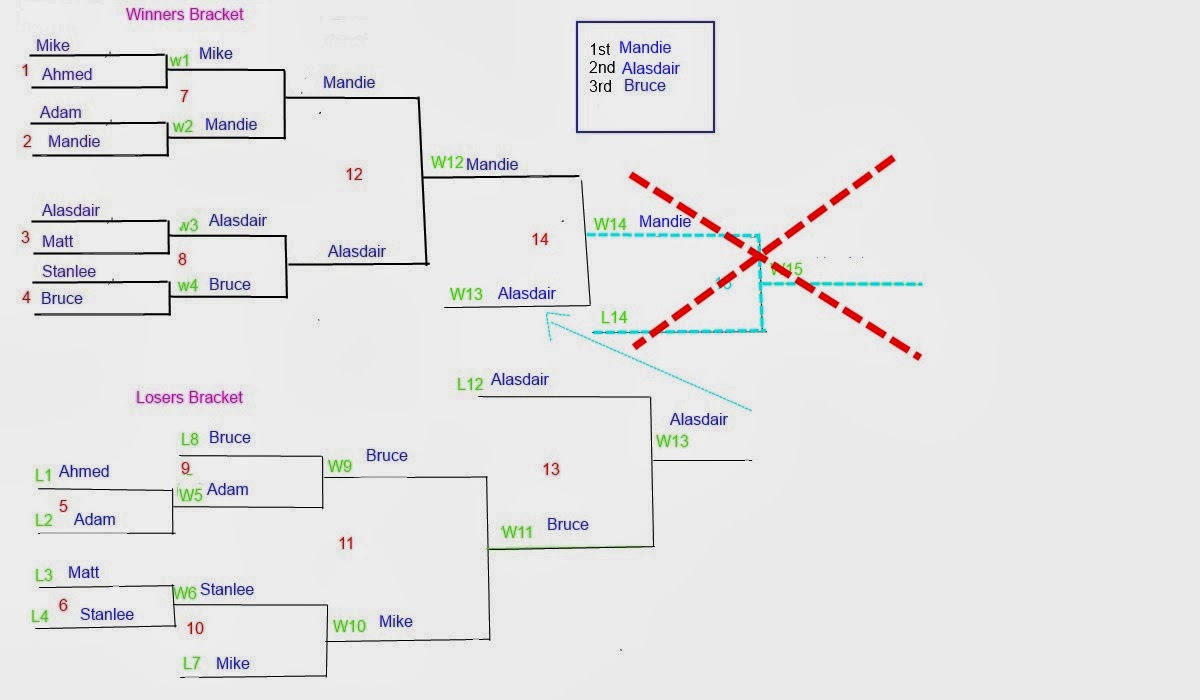
In this example, the gold medal winner has zero losses, silver has 1 loss, and bronze also has one loss. This is where one sometimes, the loser of the final, will drop down to the bottom bracket, and fight for silver/bronze. Like this:
 |
| 8 person modified double w/ fight for silver |
Here, Alasdair loses in the final, drops down to the bottom bracket, and beats Bruce, to win the silver, and Bruce gets bronze.
There is one other detail to keep in mind with double elimination. In the second round of the bottom bracket, the losers switch sides. L7 goes to the bottom half, while L8 goes to the top. This is so that they don't fight someone they have already fought. Fighting someone you have already fought becomes unavoidable at the very end in the fight for silver/bronze sometimes. As you can see Alasdair and Bruce fought in the 2nd round of the top bracket, and then they fought again in the last fight of the bottom bracket.
 |
| 13 person modified double elimination bracket |
As you can see, once you start having divisions with weird numbers, the byes complicate matters, as do the extra rounds, but the concept is still the same. When you lose at the top, you move down to the bottom, and when you lose in the bottom, you are out, keep winning, and you can work your way back to medal contention. Like in the 8 person division, some events may chose to have the loser of the last fight on the top bracket drop down to face the last fight of the bottom bracket for silver, this way gold has 0 losses, silver has 1, and bronze has 2.
True double works almost the same as either of these modified doubles, except that the winner of the bottom bracket gets a chance at the winner of the top bracket. In this case, they need to beat the winner of the top bracket TWICE to get the gold, while the winner of the top bracket needs to beat the winner of the bottom bracket just once. Thus everyone except the Gold medal winner has lost twice, in true DOUBLE elimination style. This isn't a super common way of running the sheets, but it does happen, and it's kind of interesting to see if the underdog can take the cake.
There are 3 ways that a true double elimination draw can end. #1, the winner of the top brackets defeats the winner of the bottom bracket the first time. In this case, it's over, top winner gets gold, bottom winner gets silver.
 |
| True double, the shortest ending. |
The second option is, the winner of the bottom bracket wins the first fight against the winner of the top bracket, setting them each to 1 loss each. Then the winner of the top bracket wins the 2nd fight, for gold, while the loser gets silver.
 |
| True double, top bracket winner still wins |
Finally, the winner of the bottom bracket gets the upset, defeating the winner of the bottom bracket twice in a row, and taking gold, while the loser gets silver.
 |
| The ultimate upset, true double, with the bottom bracket winner taking the gold |
So, this leaves us with the final, most complicated version of double elimination, the repechage. Like all the others, there are a couple ways that this can work, but the general idea is, if you lose, then the person that beat you has to win in order or you to get to the losers bracket.
In they Olympics, for judo, this only applies if you lose to the four athletes in the semi(they split the athletes into 2 pools and do a repechage for each side, this picture shows how it would work with only 1 pool), lose to anyone else, and your out. It sounds kind of complicated, but once you see it, it's not to bad.
This system is used when divisions are large(ish), so I will use a 16 person division to illustrate it. Sometimes, only the people who lose in the quarter finals get a second chance, which makes for a much smaller repechage bracket. All the times I have seen repechage in action, the winner of the repechage gets bronze, while the finalists get gold/silver respectively.


You see that Matt and Alex are the finalists, so everyone who lost to them, goes into the repechage. The people who lost in the first and second round face each other, then the winner of that faces the person who lost in the third round. Then the two people left in the repechage fight each other for bronze, and the finalists of the top bracket fight for gold/silver.
So that pretty much covers the basics of the double elimination style. Modified double is probably my favourite of all styles. It's efficient, and slightly more accurate at determining the podium then single elimination can be. I can't say whether I like the version where the final loser gets silver or if there is a fight for silver best, either is good. In theory, true double is the most accurate style, but to have to beat the top guy twice seems inefficient, and takes a long time, especially when you factor in the rest times between matches and whatnot.
The third and final post in this series will be on the round robin system. like single and double elimination, there are different ways of doing the draws in a round robin format.


