Showing posts with label tournament draws. Show all posts

Thursday, 2 January 2014

Tournament Draw Systems Part 3 - Round Robin

So, we talked about Single Elimination, and Double Elimination already, the only other system that is really used is Round Robin. 

Round Robin is a weird one,  it's got a million variations, and it makes a big difference how large the division is as to how it works.  The basic premise is that everyone fights everyone, and whoever has the most wins, is gold, and second most is silver, and third most is bronze.  Of course, nothing is ever that simple in the real world.

Generally, if a division is larger then 5, it will get split into "pools",  so you only fight the people in your pool, and then the winners of the pools move on to a single elimination bracket.  Also, generally, the number of pools is kept to an even number, that makes a nice single elimination bracket at the end.  The pools aren't always the same size, so sometimes people will have more fights then others.  

Sometimes, only the top 1 from each pool moves on, and sometimes top 2.  in this case, the #2's fight the #1's from the other pool.

Confused yet?  Let's add another complication.  Sometimes (quite often) there is a tie, in a pool,  in a 5 person pool, two fighters go 3-1, now what?  There are a couple ways to determine the winner:
  1. Who won the fight between the two?  That person is #1. (If there is a 3 way tie, this falls apart)
  2. It goes to points:  X points for each submission, X points for a win by points, and X points for a win by decision.
    1. If those points are tied, it sometimes goes to who score the most points in the matches, or who won their matches the quickest.
    2. Generally with those criteria someone comes out ahead, but in case they don't I would think that another fight between them happens, or they go to the first criteria I mentioned, who won the fight between the two of them.

There are many different ways that round robin draws are visualized, There isn't really a right or wrong way, but I think there are varying levels of complication and understandability when it comes to the draws.  

This style takes up the least amount of space, and is easy to calculate, BUT, it is a bit confusing at first.


This might need a bit of explanation.  Each ROW represents that persons matches.  They don't fight themselves, that is why there is that diagonal line of greyed out boxes.  Each fight, in this style of sheet, is represent in 2 boxes, one for each fighter.  As with all my other samples, the match number is in red.  The purple is all things the draw person would fill in.   As you can see, there is a lot more information that has to go into recording round robin,  to handle the times.   Personally, when I am running a mat, I record how they won for all types of sheets, just to be safe, and for the promoters records.  If I am feeling crazy, I'll write the match time down too.  

So, in this case, who gets what place depends on if they are going by option #1, or option #2.  

If we go by option #1 we have a situation,  the each loss to each other,  Fred beat Bob, who beat Same, who beat Fred. If Matt had won against Fred, then we would have had a tie for first/second and a tie for third/fourth.   Let's figure out who wins what medal,  in that revised senario.

Going by option #1.
Bob beat Sam, so Bob get's first, and Sam gets second and based on our revision above, Mat beat Fred, so Mat gets 3rd and Fred gets 4th, leaving poor, winless Joe in 5th.

Going by option #2 (still with the revision of Matt beating Fred).
Bob and Sam both have 3 wins, 2 of which are subs, and one of which are points, so in the round robin scoring, they are tied.  Next we look at how many points they scored in the match that was won by points.  Sam scored 14 points and 4 advantages, while bob scored 4 points and 2 advantages. So,  Sam wins Gold and Bob gets silver.  

Going by option #2(with the original, scoring showed in the image)
Bob and Sam are still tied on the round robin scoring, and Fred, who only has 1 submission, 1 points, and 1 decision, loses that tie breaker and gets third place, Sam still gets gold, and Bob gets silver. 

It's important to note that the round robin scoring (X points for sub, Y points for winning by points and Z points for a decision)  ONLY comes into play when there is a TIE of wins.  You cannot play the numbers,  lose more matches, but end up with more points to get the gold, no matter which way of figuring out ties is being used.


Here is another style of sheet, filled in for the exact same scenario:
In this mode,  the order of fights and who fights who is a bit more clear,  but, calculating the totals is not nearly as handy.  

Fun fact,  technically, the top or first name is supposed to be the blue/colour fighter.  So, if you are ever competing, and see the draws ahead of time, dress appropriately, or get the silly belt ready.  At big tournaments like the IBJJF worlds, for the black belt finals, they REQUIRE you to follow this rule, first fighter MUST wear ROYAL BLUE(not navy, not black, not white).   This isn't a new concept, Judo has done it forever.  At big judo tournaments, you have to wear the right colour gi as well, that is why I had to bring 4 gis to every tournament.  (a spare of each colour, in case of blood).    I personally, as a referee, fan, and competitor, like this policy, it makes keeping the fighters straight so much easier.  I hope it becomes a trend in NOGI to.  maybe have a white based rashguard and a black based rashguard or something.

I mentioned Pools earlier.  Let me illustrate that system for you now.  I got a bit lazy, and just changed the names, and the outcome of fight #10.   In a case like this, each pool could be run on a separate mat, and then the semi and final matches run once the pools are complete. Alternatively, they could be alternated doing 2 matches from pool #1, then two from pool #2 and so on. 


Now, this is all well and good, when you don't promise a number of matches to your competitors, which, the main user of round robin here in Ontario does.  Grappling Industries uses their own wacky version of round robin where you fight 4 people in your division. There isn't pools like in a standard system.  So if you have a division of 20 people, fighter # 1 might fight fighter # 2, 8, 10 and 19, then fighter #2 might fight # 1, 10, 17, and 4,  and so on.  Divisions of 2 you fight the same guy twice, divisions of 3 you fight each guy twice, divisions of 4, you get three fights.  and divisions of 5+ you fight some subset of the fighters in the division.  The table gets a list of matches for the division, which has the fighters names, and a column for the winner and what they won by.  It does work quite nicely for keeping the mat running, but it's difficult to keep track of the points and who's fighting who.

They end up with a LOT of ties,  some of which I think could be avoided using a proper pooling system.   When there are ties at grappling industries events they take all the tied people and have them battle it out in a single elimination bracket. 

This all might change, since they partnered up with Mata Leao to do their draws.  I hope they start using a more standardized system because it can cause a lot of confusion for the fighters, and the table workers using this style.


The other time you see round robin in Ontario is with KIDS divisions at OJA events. They use sheets that look similar to the second example.  For the very young kids, they split the categories into pools small enough so that every kid gets a medal, and for the older kids, they split them up so that the kids get a few fights, and then the pool winners go to a semi final and final single elimination bracket.   I think this is really fair for the kids, because it sucks for everyone to lose 1 fight and be out, and while I am all for kids learning by failing, giving them they opportunity  to compete in more then 1 match is good for them.


So, that wraps up the round robin.  There are probably some complexities that I have missed.  It creates a lot of matches, but It's a system that can create a lot of experience, and is pretty good for fairly assessing the true best competitors. 


Friday, 27 December 2013

Tournament Draw Systems Explained - Part 2 Double Elimination

Welcome back to this series on tournament draw systems.  Part one introduced the series and talked about the single elimination system.  This is part 2 and we shall talk about Double Elimination.

There are 3 main variations of Double Elimination:

  1. Modified Double
  2. True Double
  3. Double with Repechage.
Modified double is the simplest, true double is a bit more complicated and the repechage is where things get a little crazy.   Most events that use a double elimination system tend to use the modified double elimination, but the Repechage system is what is used at very high level sport events such as the Olympics.  The repechage system itself has a lot of variations, but we will get to that when we get to that.

The basic concept of double elimination is similar to single elimination, where you have rounds, and the winners move down the tree.  The difference is, once you lose, you move down to the losers bracket and have an opportunity to fight for 3rd at the very least, and in some cases, silver, or even a shot at gold.

Let's start with Modified Double Elimination. In this system,  The person who doesn't lose any gets gold, the person who loses in the final gets silver, and the winner of the losers bracket gets bronze.  Sometimes you will have the two people who got to the end of the losers bracket get bronze, but usually, in modified double, there is only 1 bronze.  Confused yet?  Let's look at a picture.  We will start with a simple 8 person division, just like we did for single elimination.

8 person modified double no fight for silver
As you can see, the concept of rounds / quarters / semis/finals gets a little muddled, because of the dual bracket, but once you follow the Ws and Ls it's pretty clear how it all works.   The losers of the first round of the top bracket fill in the first round of the bottom bracket.  The winners of the first round of the bottom bracket move on to the second round of the bottom bracket, where they are joined by the losers of the 2nd round of the top bracket. 

The losers of the 1st round of the bottom bracket have now lost twice, and are out, they place 7th.   The losers of the 2nd round of the bottom bracket have no lost twice as well, and place 5th.  The winners of the 2nd round of the bottom bracket move on to the "final" of the bottom bracket, this is the fight for third place.  The winner gets bronze/third, and the loser gets 4th.   At the top bracket,  the third round is the final, the winner gets gold, the losers gets silver.  

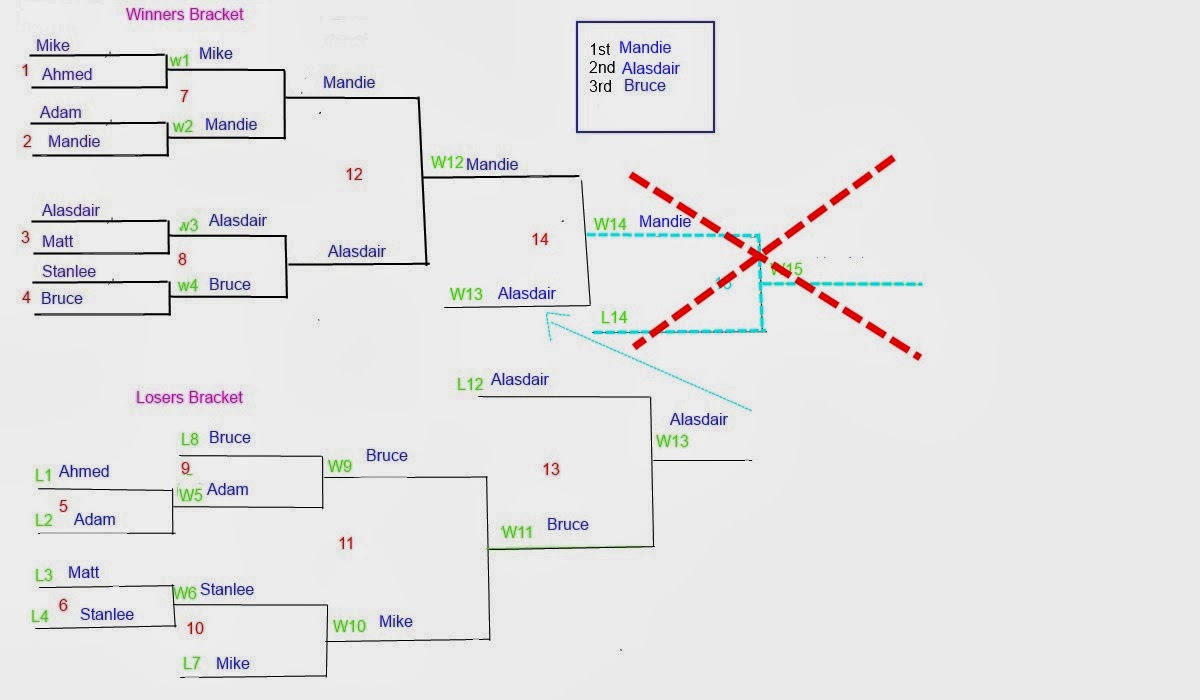
In this example,  the gold medal winner has zero losses, silver has 1 loss, and bronze also has one loss. This is where one sometimes,  the loser of the final, will drop down to the bottom bracket, and fight for silver/bronze.  Like this:
8 person modified double w/ fight for silver
 Here, Alasdair loses in the final, drops down to the bottom bracket, and beats Bruce, to win the silver, and Bruce gets bronze.  

There is one other detail to keep in mind with double elimination.  In the second round of the bottom bracket, the losers switch sides.  L7 goes to the bottom half, while L8 goes to the top. This is so that they don't fight someone they have already fought.  Fighting someone you have already fought becomes unavoidable at the very end in the fight for silver/bronze sometimes. As you can see Alasdair and Bruce fought in the 2nd round of the top bracket, and then they fought again in the last fight of the bottom bracket. 

13 person modified double elimination bracket
As you can see, once you start having divisions with weird numbers, the byes complicate matters, as do the extra rounds, but the concept is still the same.  When you lose at the top, you move down to the bottom, and when you lose in the bottom, you are out,  keep winning, and you can work your way back to medal contention.   Like in the 8 person division, some events may chose to have the loser of the last fight on the top bracket drop down to face the last fight of the bottom bracket for silver, this way gold has 0 losses, silver has 1, and bronze has 2.

True double works almost the same as either of these modified doubles, except that the winner of the bottom bracket gets a chance at the winner of the top bracket.  In this case,  they need to beat the winner of the top bracket TWICE to get the gold, while the winner of the top bracket needs to beat the winner of the bottom bracket just once.  Thus everyone except the Gold medal winner has lost twice, in true DOUBLE elimination style.   This isn't a super common way of running the sheets, but it does happen, and it's kind of interesting to see if the underdog can take the cake. 

There are 3 ways that a true double elimination draw can end.  #1, the winner of the top brackets defeats the winner of the bottom bracket the first time. In this case, it's over, top winner gets gold, bottom winner gets silver.
True double, the shortest ending.

The second option is, the winner of the bottom bracket wins the first fight against the winner of the top bracket, setting them each to 1 loss each. Then the winner of the top bracket wins the 2nd fight, for gold, while the loser gets silver.
True double, top bracket winner still wins
Finally, the winner of the bottom bracket gets the upset, defeating the winner of the bottom bracket twice in a row, and taking gold, while the loser gets silver.
The ultimate upset, true double, with the bottom bracket winner taking the gold

So, this leaves us with the final, most complicated version of double elimination, the repechage.  Like all the others, there are a couple ways that this can work, but the general idea is,  if you lose, then the person that beat you has to win in order or you to get to the losers bracket.  

In they Olympics, for judo, this only applies if you lose to the four athletes in the semi(they split the athletes into 2 pools and do a repechage for each side, this picture shows how it would work with only 1 pool), lose to anyone else, and your out.  It sounds kind of complicated, but once you see it, it's not to bad.  

This system is used when divisions are large(ish), so I will use a 16 person division to illustrate it.  Sometimes, only the people who lose in the quarter finals get a second chance, which makes for a much smaller repechage bracket.   All the times I have seen repechage in action, the winner of the repechage gets bronze, while the finalists get gold/silver respectively.

You see that Matt and Alex are the finalists, so everyone who lost to them, goes into the repechage. The people who lost in the first and second round face each other, then the winner of that faces the person who lost in the third round. Then the two people left in the repechage fight each other for bronze, and the finalists of the top bracket fight for gold/silver.

So that pretty much covers the basics of the double elimination style.  Modified double is probably my favourite of all styles. It's efficient, and slightly more accurate at determining the podium then single elimination can be. I can't say whether I like the version where the final loser gets silver or if there is a fight for silver best, either is good. In theory, true double is the most accurate style, but to have to beat the top guy twice seems inefficient, and takes a long time, especially when you factor in the rest times between matches and whatnot.  

The third and final post in this series will be on the round robin system.  like single and double elimination, there are different ways of doing the draws in a round robin format.